By Leigh Walker | Founder & CEO, Recruiterfy.ai
The wrong way to talk about AI in recruiting is as a replacement story.
It is a weak message commercially, and it is an even weaker message operationally. Candidates do not want to feel processed without care. Recruiters do not trust systems that pretend judgment can be fully automated. Clients and hiring managers still expect context, persuasion, calibration, and accountability from real people.
The better story is simpler and more honest:
AI should take repetitive work off the recruiter so the recruiter can do more of the work only a human can do.
LinkedIn’s 2025 Future of Recruiting report makes this point clearly. Talent professionals already using generative AI said it reduced workload by an average of 20%, and LinkedIn also found employers were 54 times more likely to list relationship development as a required skill for recruiters than they were a year earlier. LinkedIn’s conclusion was direct: AI is enabling recruiting teams to be more human, not less.
Bullhorn’s recruiting research points the same way. In the 2025 GRID Industry Trends Report, recruitment leaders repeatedly said AI had to enhance – not replace – the human aspect of recruiting. In Bullhorn’s 2026 Industry Trends data, recruiters reported that AI makes screening 50% to 75% faster, allowing them to focus more on high-value client relationships.
Candidate data tells a similar story.
Bullhorn’s 2025 Talent Trends findings showed that 77% of candidates who had interacted with AI in the job-search process rated the experience positively. But that same research also found that 72% of candidates had stopped working with a recruiter because of poor communication and slow responsiveness.
Those two facts belong together.
Candidates are not rejecting AI outright.
They are rejecting silence, delay, and generic treatment.
When AI helps a recruiting team respond faster, acknowledge every application, and keep communication moving, candidates see value. Bullhorn said AI can raise candidate loyalty by as much as 45%, and even one communication touchpoint per week can push loyalty to 86%.
That is not a replacement use case. It is a support use case.
Recruiterfy is built around exactly that philosophy.
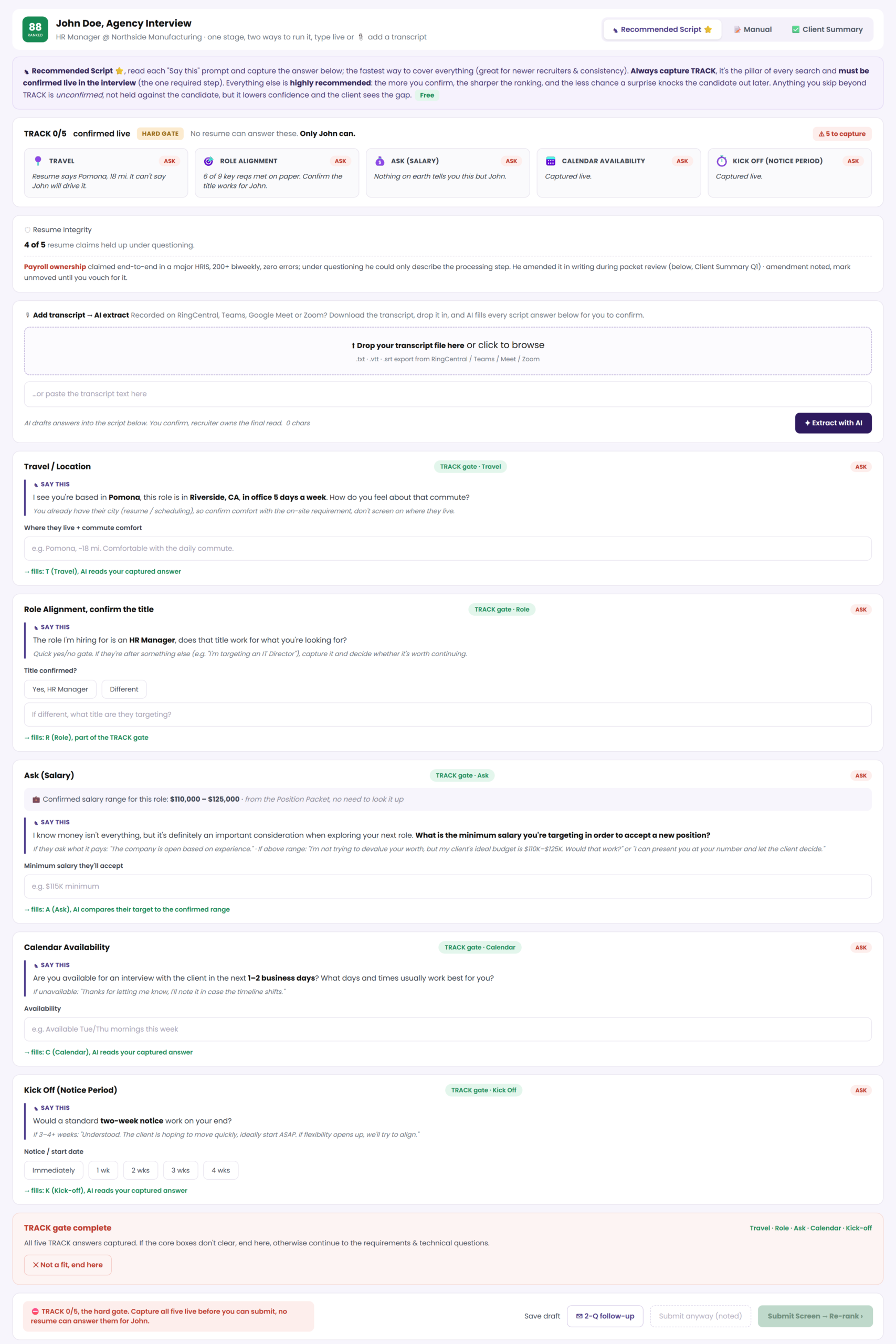
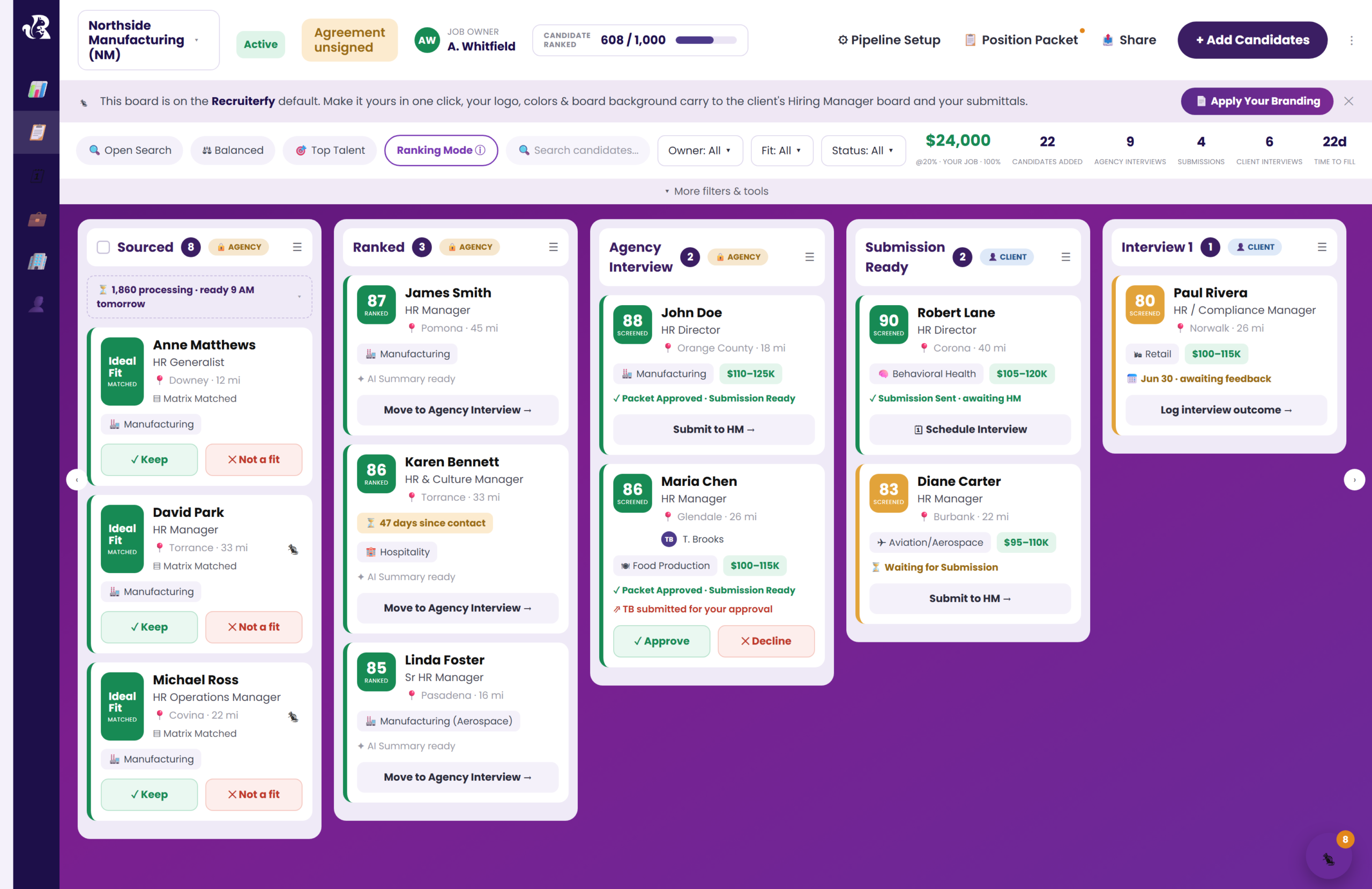
Recruiterfy is not trying to remove the recruiter from the process. It is designed to automate the time-consuming data work around the recruiter: pre-screening, ranking, structured summaries, and pipeline support. That means the recruiter gets more time for intake calls, candidate conversations, shortlist calibration, objection handling, and relationship-building – the work that actually changes outcomes.
This human-in-the-loop position matters for another reason: direction and context still shape AI quality.
A model can help organize information. It can help compare profiles. It can help standardize repetitive work. But it still needs a role definition, evaluation criteria, business context, and recruiter oversight. It still needs someone to decide what matters most for this client, this role, and this moment in the search.
That someone is the recruiter.
The most effective recruiting teams will use AI like a force multiplier, not a substitute. They will automate the predictable parts and protect the relational parts.
That is how productivity goes up without degrading candidate experience.
That is how responsiveness improves without flattening judgment.
And that is how recruiters stay central in a market that increasingly rewards both speed and trust.
Recruiterfy’s position should be clear:
AI is here to remove workflow friction.
Recruiters are here to build confidence and make decisions.
The future of recruiting needs both.
One hundred founding teams get Recruiterfy at the best rate we will ever offer, with a
live founder session every week. Admission is by application, and we cap how many
firms we admit per specialty and region.
Qualify for the Founders Club
Not sure yet? Join the Waitlist for launch updates, early product previews.