By Leigh Walker | Founder & CEO, Recruiterfy.ai
General-purpose AI tools are impressive. They are fast, flexible, and often very good at first-draft work.
For recruiters, that makes them useful for brainstorming outreach, rewriting job ads, summarizing resumes, or quickly organizing rough notes. Used well, tools like ChatGPT and Claude can absolutely improve productivity.
But there is a big difference between an impressive draft and a dependable workflow.
Recruiting teams do not just need helpful output. They need repeatable output. They need candidate summaries in the same structure every time. They need evaluation criteria that stay stable across recruiters. They need company and role context to flow through the process consistently. They need data that can actually be reused in the CRM, ATS, and pipeline – not just copied from one chat window into another.
That is where many teams hit the wall with generic AI.
The limitation is not that the models are weak. The limitation is that unstructured prompting creates variability. One day the summary is long. The next day it is short. One recruiter gets three reasons for fit. Another gets seven. One response includes missing fields. Another changes the tone. Helpful? Yes. Operationally reliable? Not always.
The model providers themselves now document this distinction very clearly.
OpenAI introduced Structured Outputs specifically because valid JSON alone was not enough for production reliability. OpenAI says Structured Outputs are designed to ensure model-generated outputs exactly match developer-supplied JSON schemas, and on its evals, the company reported 100% reliability for the GPT-4o model used with Structured Outputs on complex schema-following tasks. Anthropic makes the same point in its own documentation, stating that Structured Outputs provide guaranteed schema compliance when teams need Claude to always return valid JSON in a specific structure.
In plain English: if the work matters downstream, structure matters.
Recruiting is full of downstream dependencies. A candidate summary is not just text. It becomes a note. A ranking. A shortlist explanation. A submission artifact. A decision record. A search input for the next role. A data point that shapes how the team works tomorrow.
That means consistency is not a nice-to-have. It is operational leverage.
Bullhorn’s 2025 GRID Industry Trends Report adds an important recruiting-specific layer to this. The report found that 37% of agencies said data limitations – siloed systems and weak data hygiene – were the biggest barrier to realizing AI benefits. In the same report, recruitment leaders said AI had to be customizable and trained on their own data if it was going to support the human side of recruiting rather than create more noise.
That is the gap Recruiterfy is built to close.
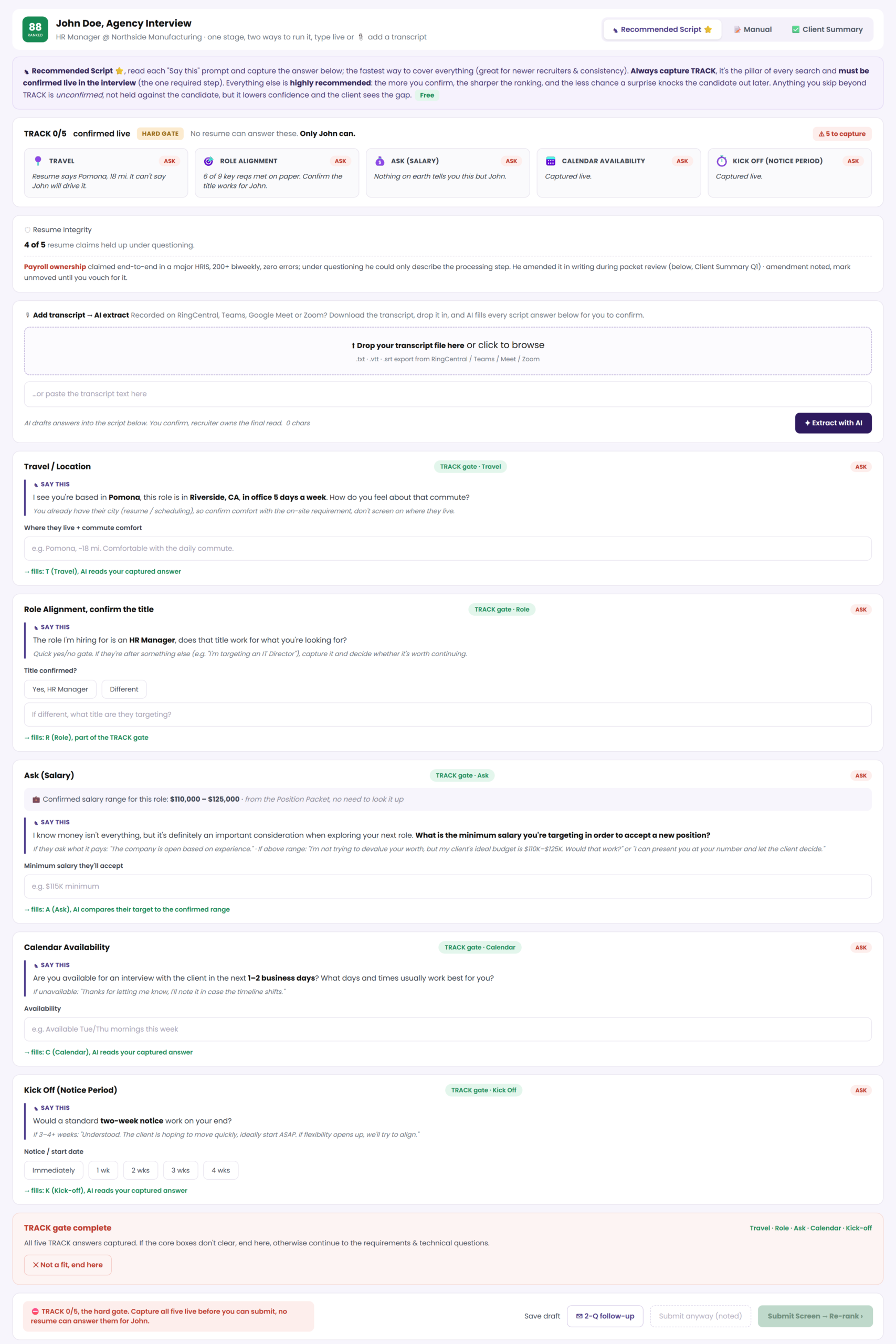
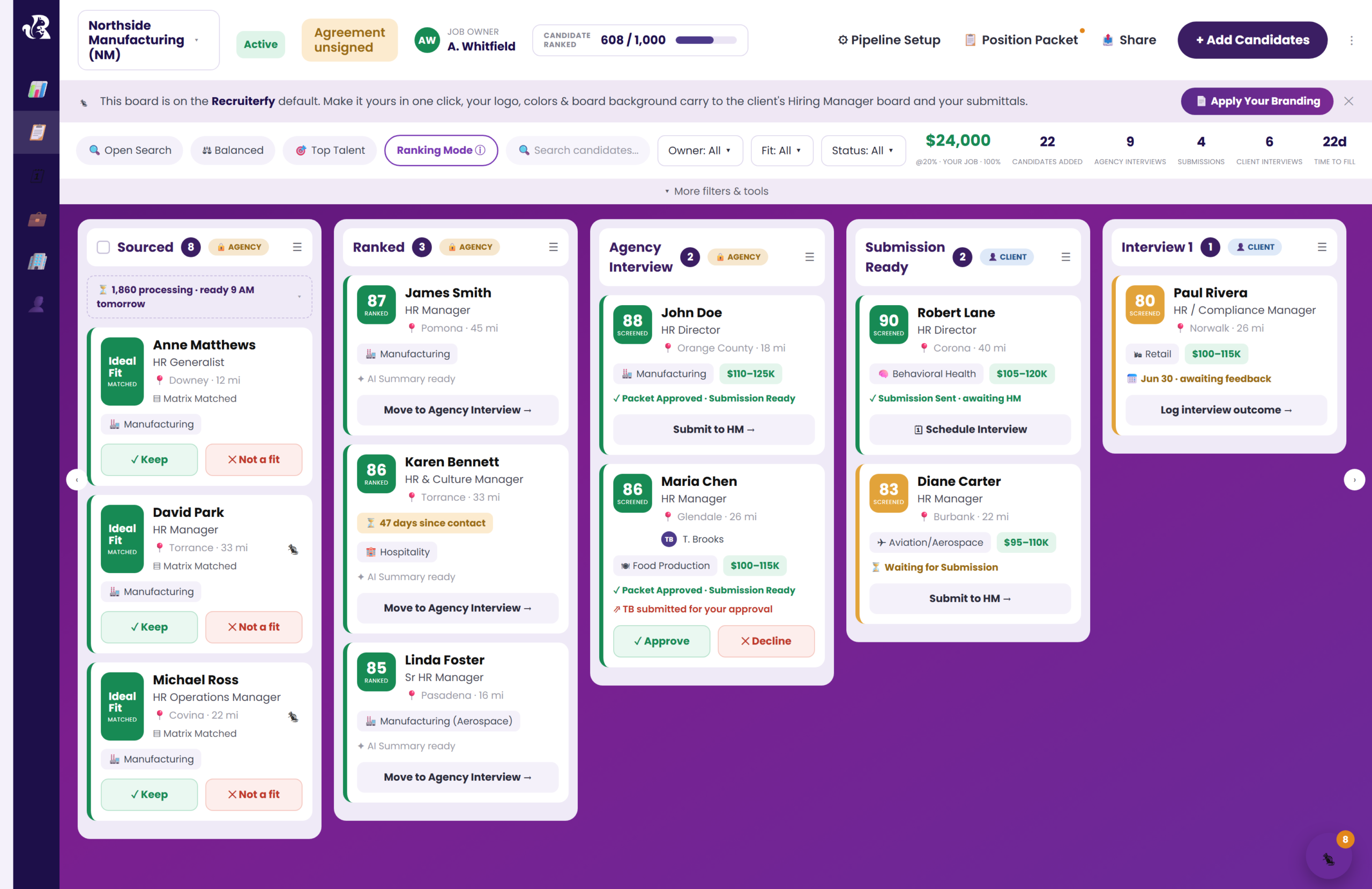
Recruiterfy is not positioned as a generic chat box for recruiting prompts. It is designed as a structured recruiting workflow. That means candidate summaries can follow a repeatable format. Matching logic can remain anchored to consistent criteria. Ranked outputs can be easier to compare. And pipeline actions can happen in a way that is useful for the team, not just interesting in the moment.
The practical benefit is bigger than “cleaner output.”
Consistent summaries make handoffs easier between recruiters and managers.
Consistent scoring makes shortlists easier to defend with clients.
Consistent structure makes reporting more meaningful.
Consistent context makes future candidate rediscovery more reliable.
Most of all, consistent AI helps teams trust the workflow.
That trust matters because recruiting is one of the fastest ways for a small inconsistency to become a big commercial problem. A missing note can lose a candidate. A weak summary can delay a shortlist. An inconsistent evaluation can create confusion with a client. A field that cannot be reused in the system becomes more manual clean-up later.
Generic AI still has a place. It is excellent for drafting, ideation, and fast ad-hoc work. But when your team needs repeatable recruiting operations, the answer is not “better prompting forever.” It is structure, rules, context, and accountability.
Recruiterfy’s value is that it treats AI as part of a recruiting system, not as a one-off assistant.
That is how teams move from interesting output to dependable execution.
One hundred founding teams get Recruiterfy at the best rate we will ever offer, with a
live founder session every week. Admission is by application, and we cap how many
firms we admit per specialty and region.
Qualify for the Founders Club
Not sure yet? Join the Waitlist for launch updates, early product previews.