By Leigh Walker | Founder & CEO, Recruiterfy.ai
Most AI recruiting evaluations start the wrong way.
The demo looks impressive.
The feature list is long.
The automation promises sound modern.
And six months later the team is still copying information between systems, arguing over data quality, and wondering why the new tool did not meaningfully change recruiter output.
The issue is rarely “AI does not work.” The issue is usually that teams buy point capabilities instead of operational outcomes.
That matters more than ever in 2026 because the buying pressure is real. Employ’s 2025 Recruiter Nation Report found that 39% of respondents listed updating or adopting new recruitment software as a top priority, up sharply from the prior year. The same report found planned budget increases flowing most heavily toward AI-powered recruiting tools (67%), CRM systems (51%), and ATS platforms (50%).
In other words, many teams are about to buy multiple answers to the same problem.
SHRM has already warned about this broader pattern, noting in 2025 that HR technology ecosystems have become bloated with expensive solutions. Recruiting leaders do not need more disconnected intelligence layered on top of broken workflows. They need fewer handoffs, better data usability, and stronger decision support inside the workflow they already run.
Bullhorn’s 2026 GRID Industry Trends findings make the stakes clear. Agencies using AI at any stage of the recruitment cycle were 3.5x to 4.5x more likely to have seen increased revenue, but only 10% of firms had implemented agentic AI across their full workflow. The same Bullhorn research said many firms were still held back by data readiness, security concerns, and unclear implementation strategy.
So how should you compare platforms?
Start by separating the market into categories.
Generic LLM tools are useful for drafting and idea generation, but they usually depend on manual prompting and manual transfer back into the recruiting system.
ATS AI add-ons can improve native workflow convenience, but many are limited by the structure and usability of the underlying database.
Sourcing point solutions can help widen the funnel, but they often create another screen, another dataset, and another handoff.
Workflow and database-first platforms aim to make existing recruiting data more usable, improve matching, and reduce top-of-funnel admin inside the recruiting process itself.
That last category is where the commercial value tends to be strongest, because it changes how the team works every day – not just what the team can experiment with.
From there, evaluate six criteria.
First, data foundation.
If the platform cannot work with messy real-world recruiting data, it will disappoint you. Ask how it handles incomplete records, inconsistent titles, duplicate profiles, old notes, and weak tagging. If the answer assumes perfect data, the value will collapse in production.
Second, candidate rediscovery.
Does the platform help you find aligned candidates already inside your recruiting history, or does it mostly help with fresh sourcing? If your team restarts discovery from zero every time, you are leaving margin on the table.
Third, workflow consistency.
Can the system generate structured summaries, repeatable rankings, and pipeline-ready outputs? Or is it mostly a clever drafting tool? Consistency determines whether the output becomes reusable operational value.
Fourth, recruiter control.
Does the recruiter understand why a candidate was surfaced? Can they override, refine, and steer the logic? Human-in-the-loop design is not a compliance detail. It is the reason teams trust the output enough to use it.
Fifth, actual time recovery.
Does the tool remove manual screening, ranking, note generation, and data-entry work? Or does it simply produce more text that recruiters still have to verify and move manually?
Sixth, reporting and leadership visibility.
Can the platform help you measure rediscovery rate, screening efficiency, shortlist speed, and quality-of-fit? Or does it stop at task assistance?
This is where Recruiterfy should stand out in the market.
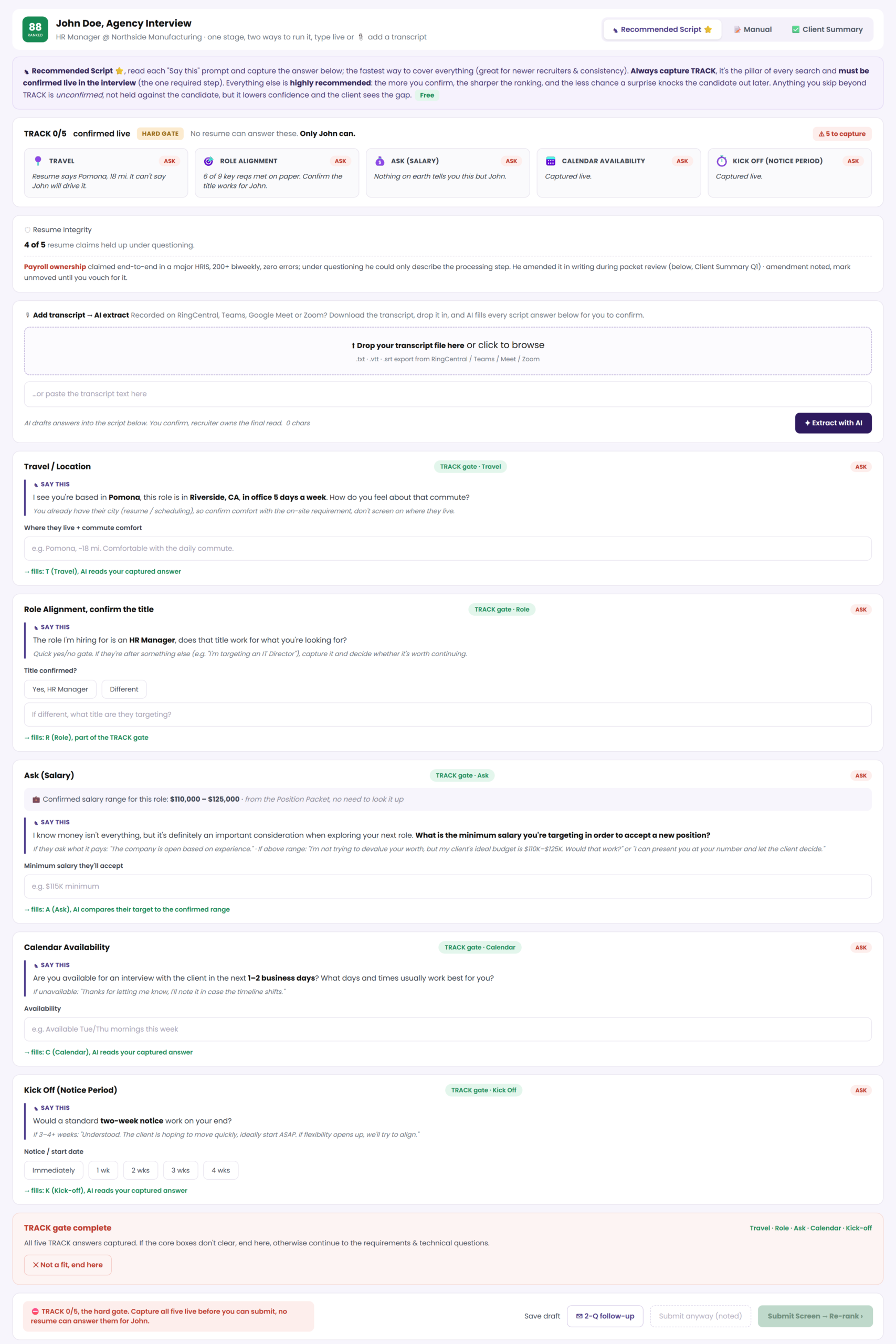
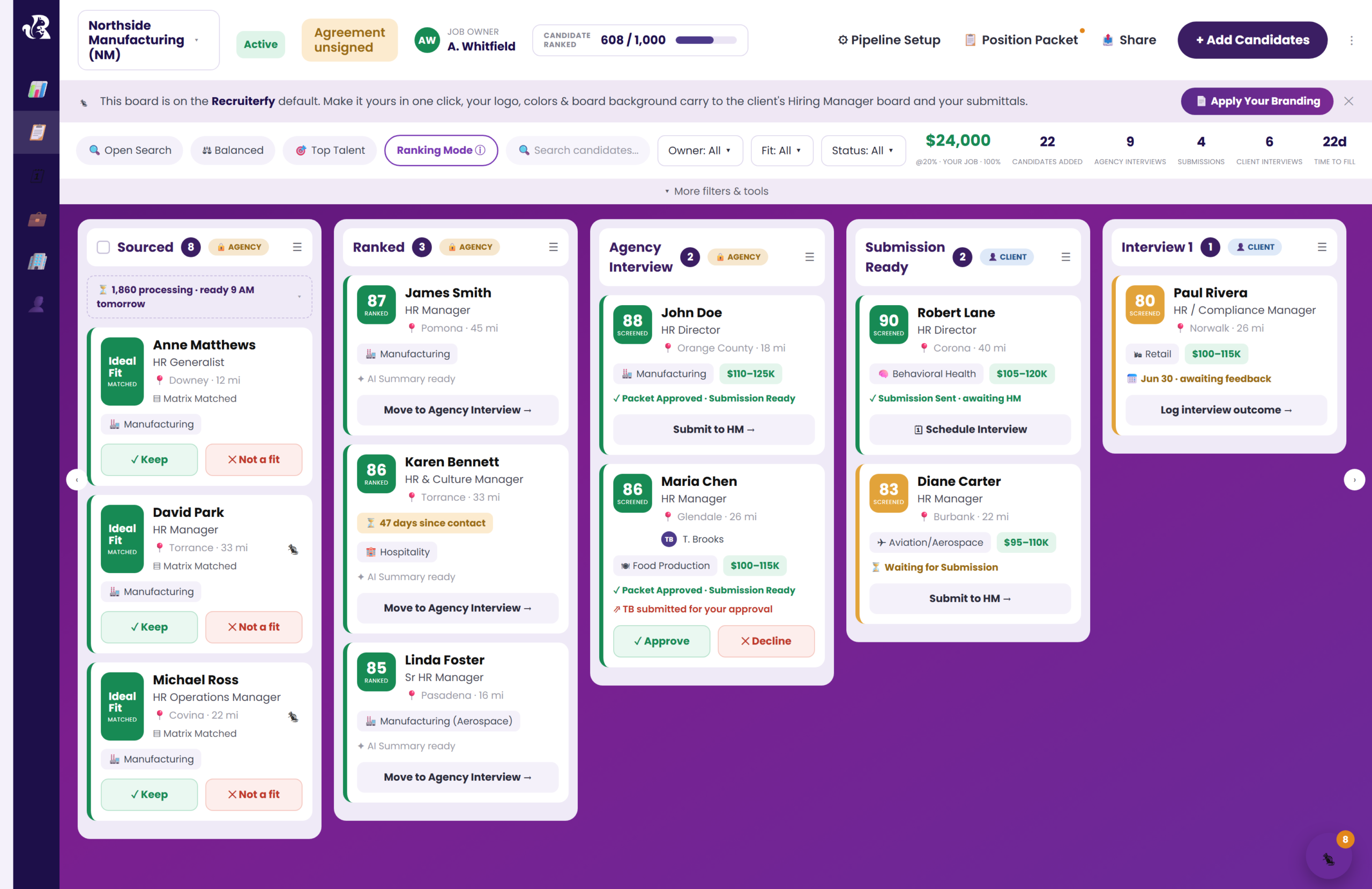
Recruiterfy is positioned around a very specific problem: helping recruiting teams use AI to surface aligned candidates, pre-screen more consistently, rank better, and automate the data-heavy work that slows the top of the funnel. That is a more operationally useful promise than generic “AI for recruiting” language because it maps directly to recruiter productivity, candidate rediscovery, and time-to-shortlist.
The point of comparison should not be “Which platform has the most AI?”
It should be:
Which platform makes recruiters faster?
Which platform makes existing data more useful?
Which platform reduces system-switching?
Which platform improves repeatability without removing human judgment?
Buying another AI tool is easy.
Buying less fragmentation is harder.
That is why the best recruiting platform decisions in 2026 will be made by teams that evaluate workflow architecture, not just feature excitement.
Recruiterfy belongs in that kind of evaluation.
One hundred founding teams get Recruiterfy at the best rate we will ever offer, with a
live founder session every week. Admission is by application, and we cap how many
firms we admit per specialty and region.
Qualify for the Founders Club
Not sure yet? Join the Waitlist for launch updates, early product previews.