By Leigh Walker | Founder & CEO, Recruiterfy.ai
Ask almost any recruiter where time disappears, and the answer is usually the same: the top of the funnel.
Not the final interview. Not the offer stage. Not even client management. The real time drain is the work that happens before a meaningful candidate conversation ever starts.
Sourcing, sorting, summarizing, comparing, writing notes, updating systems, and trying to decide who deserves the first call.
That is exactly why so many teams feel busy without feeling productive.
Bullhorn’s 2025 GRID Industry Trends Report found that recruiters spend 14.6 hours per week searching for the right candidates. The same report said agencies believe AI applied across the workflow could return roughly 17 hours per recruiter per week, including about 4.2 hours from search and match and another 4 hours from the sorting work that happens before anyone picks up the phone.
LinkedIn’s 2025 Future of Recruiting report reached a similar conclusion from a different angle. Talent professionals already using generative AI reported an average 20% reduction in workload, roughly a full day back each week.
That saved time matters because recruiting is still, at its core, a relationship business.
Bullhorn’s 2025 Talent Trends research found that 72% of candidates stopped working with a recruiter because of poor communication or slow responsiveness. The same research showed that AI in the recruiting process can increase candidate loyalty by as much as 45%, and that even simple weekly communication can lift loyalty to 86%.
So the prize is not automation for its own sake. The prize is responsiveness, consistency, and more recruiter capacity for the conversations that actually decide a
placement.
What we will not do
There is a version of AI recruiting where the software decides who is worth talking to and the recruiter is handed a shortlist with no explanation. We are not building that, and we do not think it works.
Recruiterfy does not screen people out. It does not judge whether someone will fit your client’s culture. It does not decide that a career gap disqualifies a candidate, or that an unfamiliar job title means the experience does not count. Those are judgments, and judgments belong to a person who has spoken to the candidate and who knows the client.
A machine that has never met either one should not be making them.
What we do instead
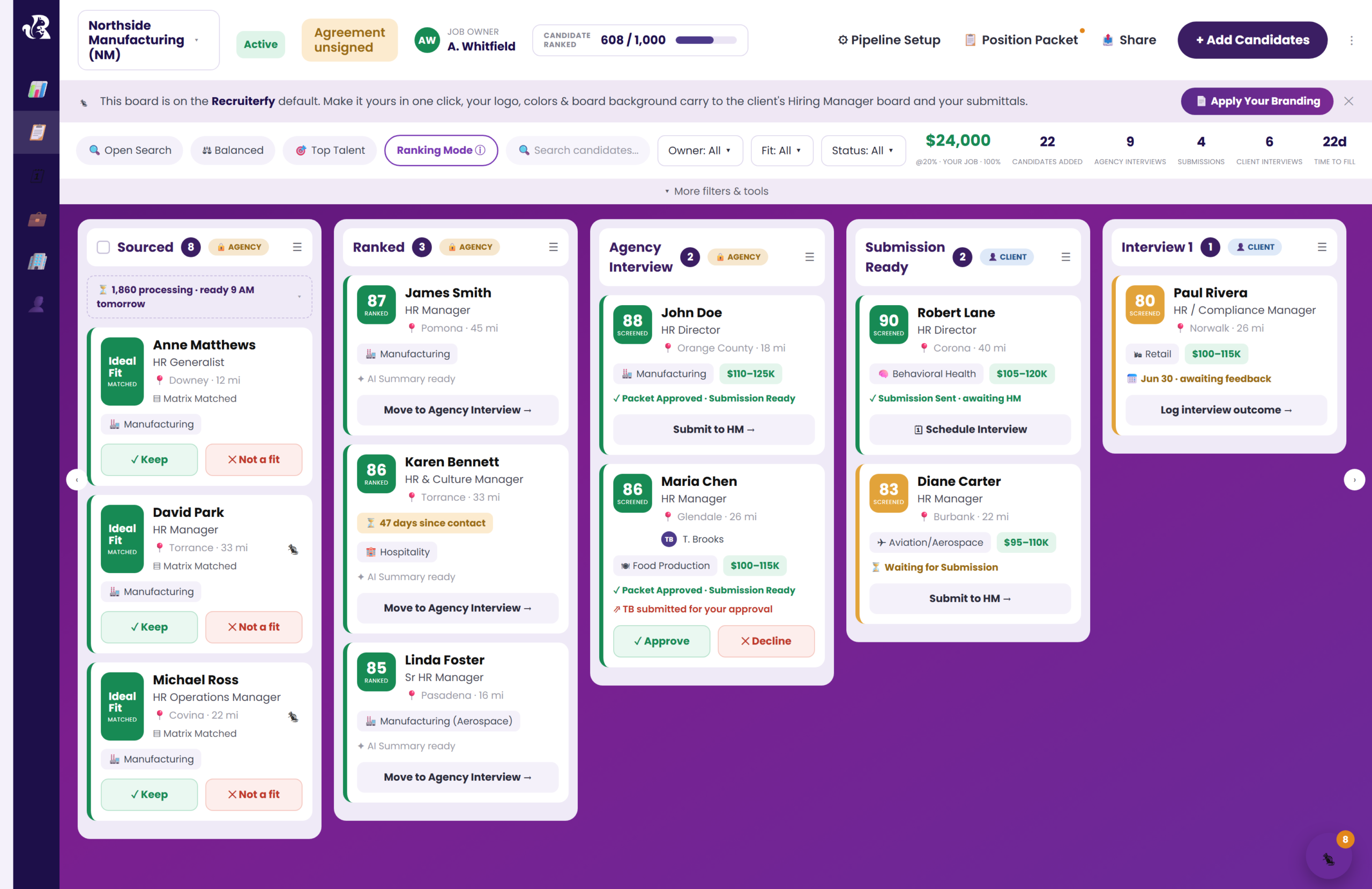
Recruiterfy maps the whole role rather than the job description, then ranks every candidate against it on cited evidence. Every score points back to the specific line in the resume or the transcript that produced it, so you can see the reasoning rather than take it on trust.
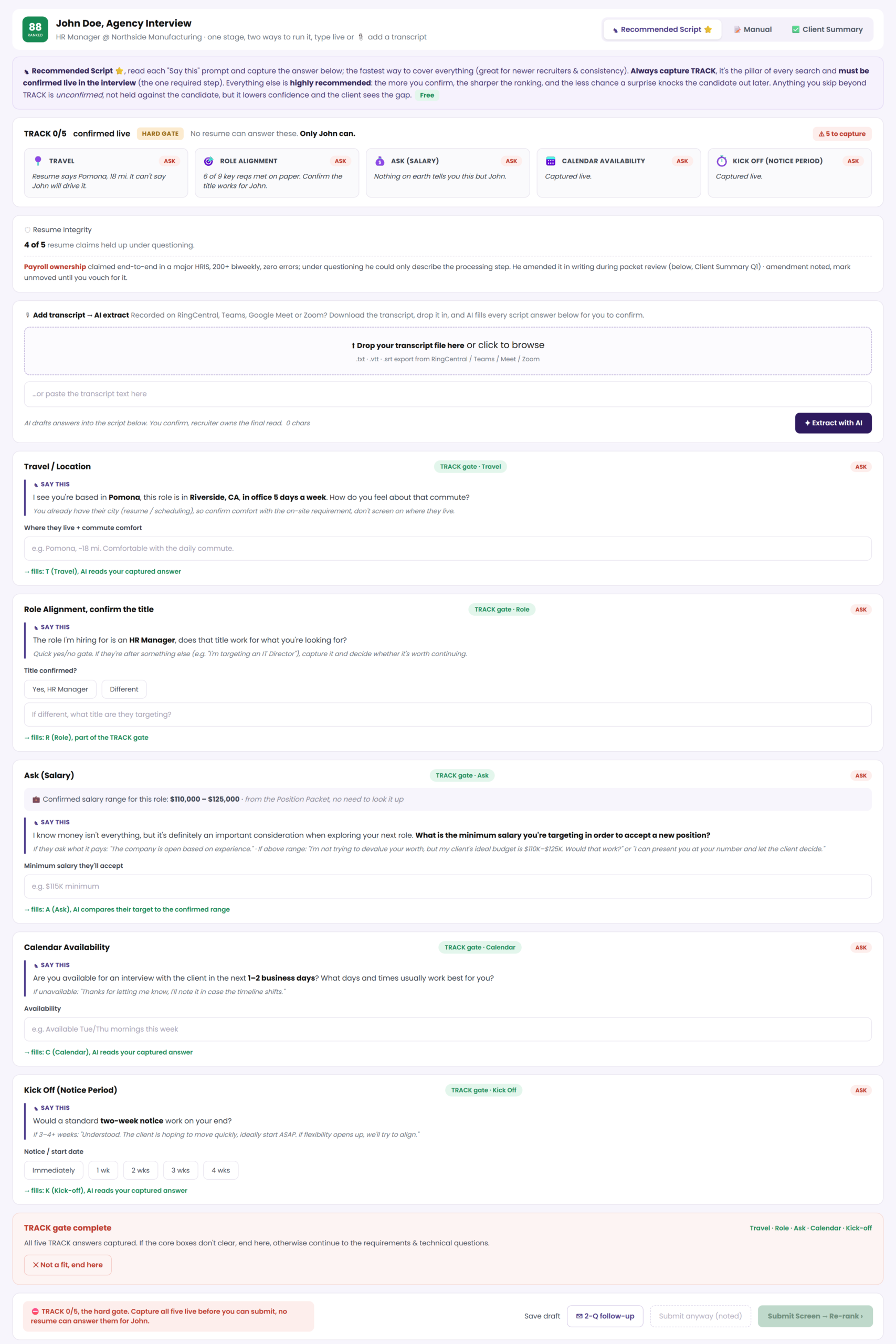
Then it does the part that saves the most time and gets talked about the least. It tells you what to ask.
For every candidate on your shortlist, Recruiterfy shows you what the evidence already supports, what is missing, and what is unclear. It turns the gaps into specific questions worth asking in the interview. Not generic competency questions, but the two or three things that would actually confirm or break that candidate’s case for this particular role.
You still run the interview. Every time. What changes is that you walk into it knowing exactly what you are trying to find out.
The interview is the point, not the obstacle
The problem was never that recruiters interview too many people. It is that they interview the wrong people, and then have to work out what to ask once they are already on the call.
Instead of speaking with twenty candidates to discover which three are worth a serious conversation, you start with the three. Your job on those calls is the job you are actually good at: confirming that the experience is real and as described, and forming a view on whether this person will work well with the team and the client. That is a human assessment. It should stay one.
Instead of spending the morning sorting profiles, you start with a ranked shortlist you can interrogate. Instead of rewriting candidate summaries from scratch, you get a structured starting point. Instead of bouncing between notes, job descriptions and past activity, you get organized context in one place.
That does not replace recruiting. It restores it.
Employ’s 2025 Recruiter Nation Report reinforces the same shift. Among teams using AI in recruiting, 55% reported faster time to hire, 53% reported better candidate quality, and 49% reported higher recruiter productivity. Just as importantly, teams said the time saved was being redirected into higher value work: recruiter and hiring manager upskilling, high touch candidate engagement, and better analytics.
Why the top of the funnel decides everything
The beginning of the pipeline is where searches are won or lost. If the shortlist is weak, late, inconsistent or bloated, every stage after it suffers. Client confidence drops. Candidates disengage. Recruiters get buried in admin. Time to fill drifts.
When the first pass is faster and better evidenced, everything downstream improves. Recruiters respond faster. Candidates feel seen sooner. Hiring managers get shortlists they can defend. Teams spend more time building relationships instead of clearing workflow debt.
That is the real promise of recruiting AI. Not fewer recruiters. Not automated judgment. Better recruiter time, better recruiter focus, and better recruiter conversations.
Recruiters should recruit. Recruiterfy is built to make that possible, and to stay out of the decisions that were never ours to make.
One hundred founding teams get Recruiterfy at the best rate we will ever offer, with a
live founder session every week. Admission is by application, and we cap how many
firms we admit per specialty and region.
Qualify for the Founders Club
Not sure yet? Join the Waitlist for launch updates, early product previews.