By Leigh Walker | Founder & CEO, Recruiterfy.ai
Job titles are a terrible source of certainty.
The same job can have three names across three companies.
The same title can mean different things in different industries.
And some of the strongest candidates for a role may never have held the exact label you are searching for.
That is why title-first recruiting keeps missing good people.
The labor market itself is moving toward a skills-first reality. The World Economic Forum’s Future of Jobs Report 2025 found that employers expect 39% of workers’ core skills to change by 2030. If the required skills behind roles are shifting that quickly, then titles become an even weaker shortcut for finding fit.
LinkedIn’s 2025 Future of Recruiting report supports the same point from a hiring-outcomes perspective. It found that 93% of talent acquisition professionals believe accurately assessing candidate skills is crucial for improving quality of hire, and companies with the most skills-based searches were 12% more likely to make a quality hire.
SHRM’s 2025 skills-first research shows the behavior shift is already underway. In 2025, 78% of HR professionals said skilled credentials were used sometimes, often, or almost always in their hiring processes. SHRM also found that 34% of organizations now often or almost always use skills-first hiring strategies, and organizations that used skills-first approaches more consistently were more likely to exceed financial objectives.
That last point matters. Skills-first is not just a sourcing philosophy. It is increasingly a performance strategy.
This is where Recruiterfy aligns well with where recruiting is already heading.
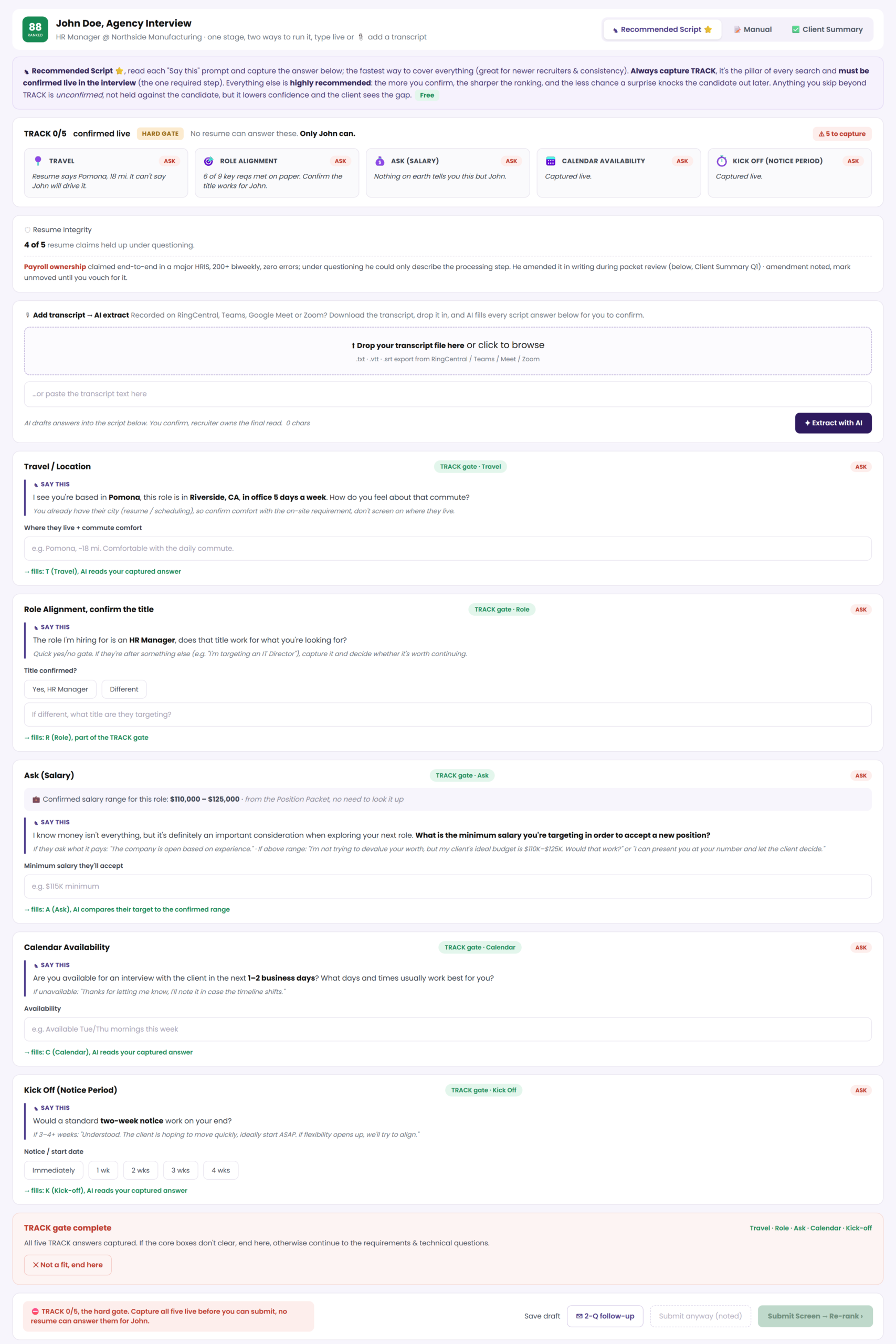
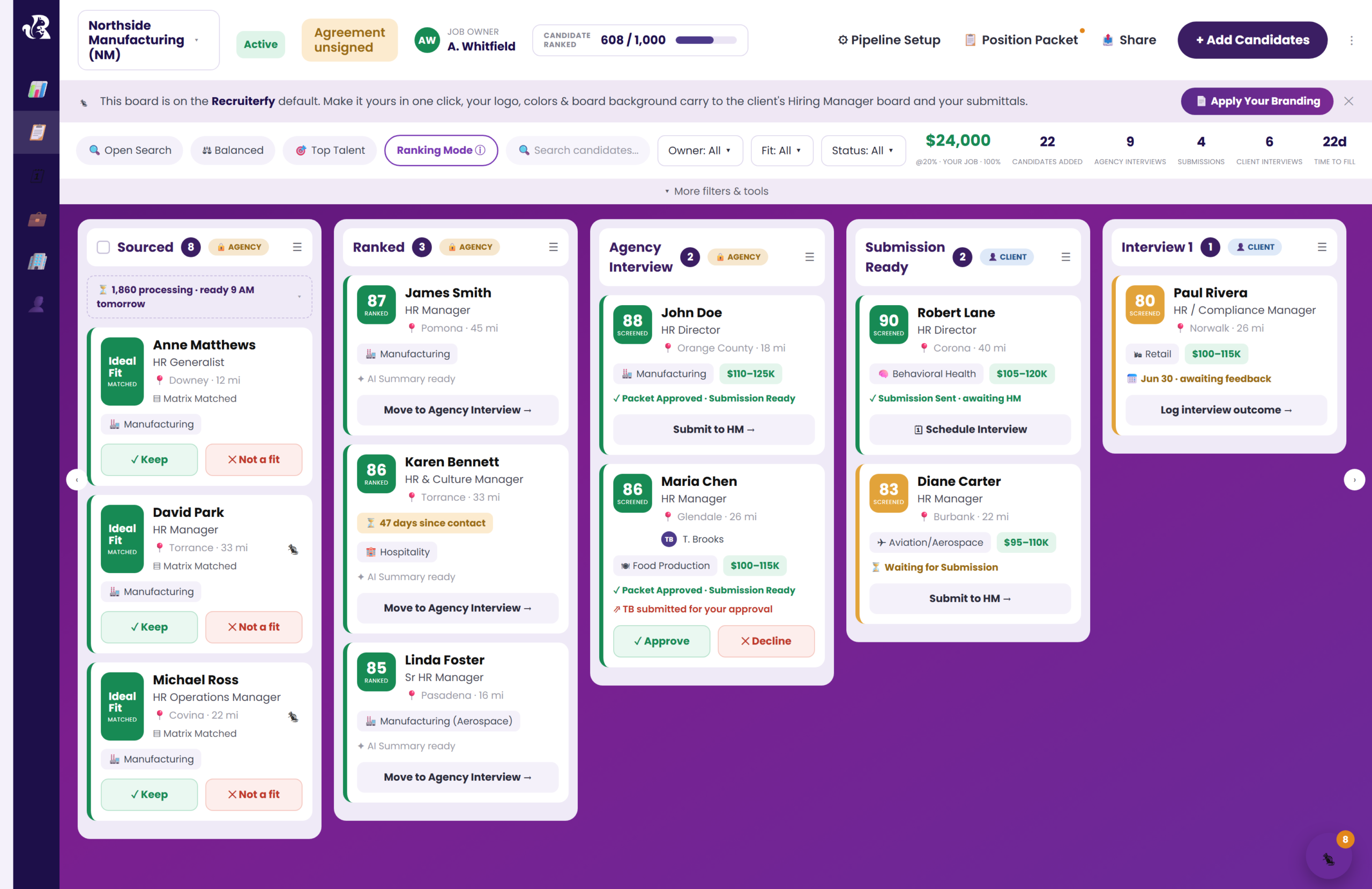
Recruiterfy’s candidate matrix is built for alignment, not just title match. Instead of asking whether a candidate’s last role uses the exact same wording as the current vacancy, Recruiterfy can help recruiters evaluate a broader set of signals: skill overlap, adjacent experience, role progression, relevant context, and likely fit.
That is important because many of the best candidates in the market are “one step sideways” from the brief, not one exact keyword away from it.
A title-first approach tends to reward familiarity. A skills-first approach tends to reward capability.
That does not mean titles are useless. Titles still provide context. Seniority still matters. Industry language still matters. But titles should be one input, not the whole search strategy.
Skills-first matching is especially powerful in three situations.
First, emerging roles.
When the market is changing faster than taxonomies can keep up, skills tell you more than labels.
Second, adjacent-fit hiring.
Some candidates can perform well in a role because they have the right underlying competencies, even if their last job title was not identical.
Third, diverse pipeline building.
Title-heavy search often narrows the market too early. Skills-first search expands legitimate option sets without lowering standards.
For recruiters, the operational benefit is speed with better reasoning. Instead of debating whether a title “counts,” the team can evaluate whether the candidate can actually do the work. That produces better shortlists and more defensible recommendations.
For leadership, the benefit is resilience. The faster skills evolve, the less safe it is to depend on static labels.
Recruiterfy is valuable here because it brings skills-first logic into the workflow in a way recruiters can actually use. Rather than treating skills-based hiring as a slogan, it helps translate it into candidate ranking and prioritization.
That is where the market is going.
Titles will still exist.
But titles alone will not be enough.
The teams that win will be the ones that can search for capability, not just familiarity.
One hundred founding teams get Recruiterfy at the best rate we will ever offer, with a
live founder session every week. Admission is by application, and we cap how many
firms we admit per specialty and region.
Qualify for the Founders Club
Not sure yet? Join the Waitlist for launch updates, early product previews.