By Leigh Walker | Founder & CEO, Recruiterfy.ai
The most expensive candidate is often not the one you have never met. It is the one your firm already spoke to, already screened, or already placed into a shortlist once before – and then failed to find again when a new role opened.
That is the hidden cost inside modern recruiting. Teams tell themselves they are buying access to new candidates. In reality, they are often paying to rediscover talent they already touched across email, spreadsheets, recruiter notes, CRM records, ATS entries, job board activity, and disconnected team workflows.
This is not an argument against LinkedIn or Indeed. Job boards matter. They are important channels for reach, brand visibility, and top-of-funnel demand. The problem starts when they become your first search every time because your own systems cannot reliably surface the right people from your existing history.
And that problem is getting more expensive.
Appcast’s February 2026 analysis of its 2026 Recruitment Marketing Benchmark Report said recruiting got more expensive in a softer labor market because job boards and media platforms are changing their cost models, organic reach has shrunk over time, and employers are being pushed into more pay-to-play distribution. Appcast also noted that overall apply rates improved to 5.19% in 2025, but higher volume did not automatically create better efficiency. More applicants still meant more screening, more work, and often more cost. That is the exact environment where candidate rediscovery becomes a competitive advantage.
Bullhorn’s 2025 GRID Talent Trends data adds another warning sign: only 35% of candidates now turn to recruitment agencies first in their job search. In other words, agencies are fighting harder for attention while candidates have more ways to bypass recruiter relationships entirely. When that happens, your internal candidate memory matters more, not less.
Bullhorn’s 2025 GRID Industry Trends Report makes the business case even clearer. Agencies that could rely on their candidate database were more than twice as likely to have increased revenue. The same report also found that 37% of agencies said data limitations – either siloed systems or weak data hygiene – were the biggest barrier to getting real value from AI.
That is the real issue. Not “do we have enough candidates?” but “can we actually find, understand, and reuse the candidates we already know?”
Traditional CRM and ATS workflows usually struggle here for a simple reason: they depend on perfect manual upkeep. A recruiter has to remember to log the interaction, apply the right tags, keep notes current, update stage movement, and standardize naming across the team. In the real world, that rarely happens cleanly enough for fast rediscovery later. One recruiter writes “AE”. Another writes “account executive”. Another writes “SaaS sales”. A great candidate disappears behind fragmented language, partial notes, and old tags.
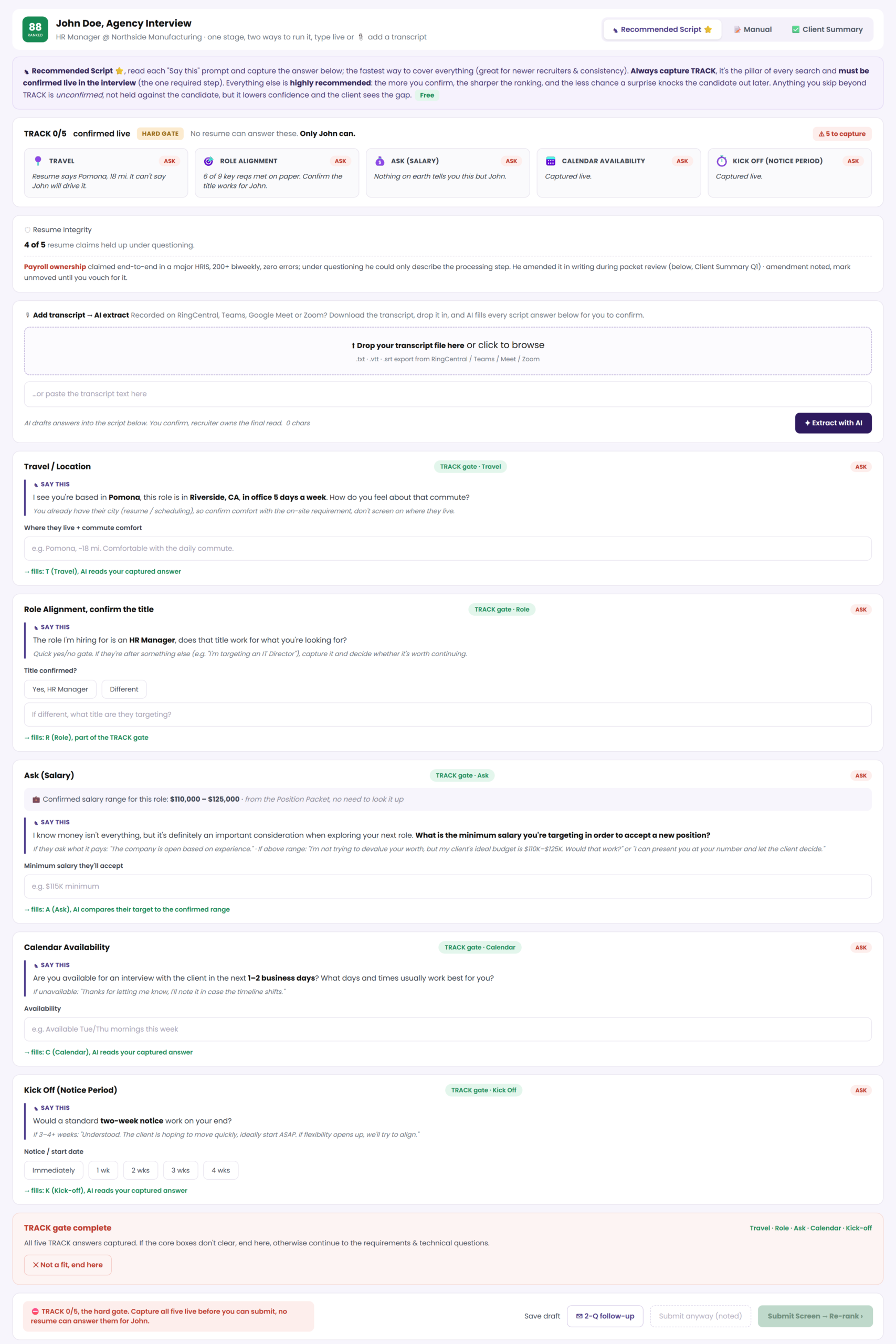
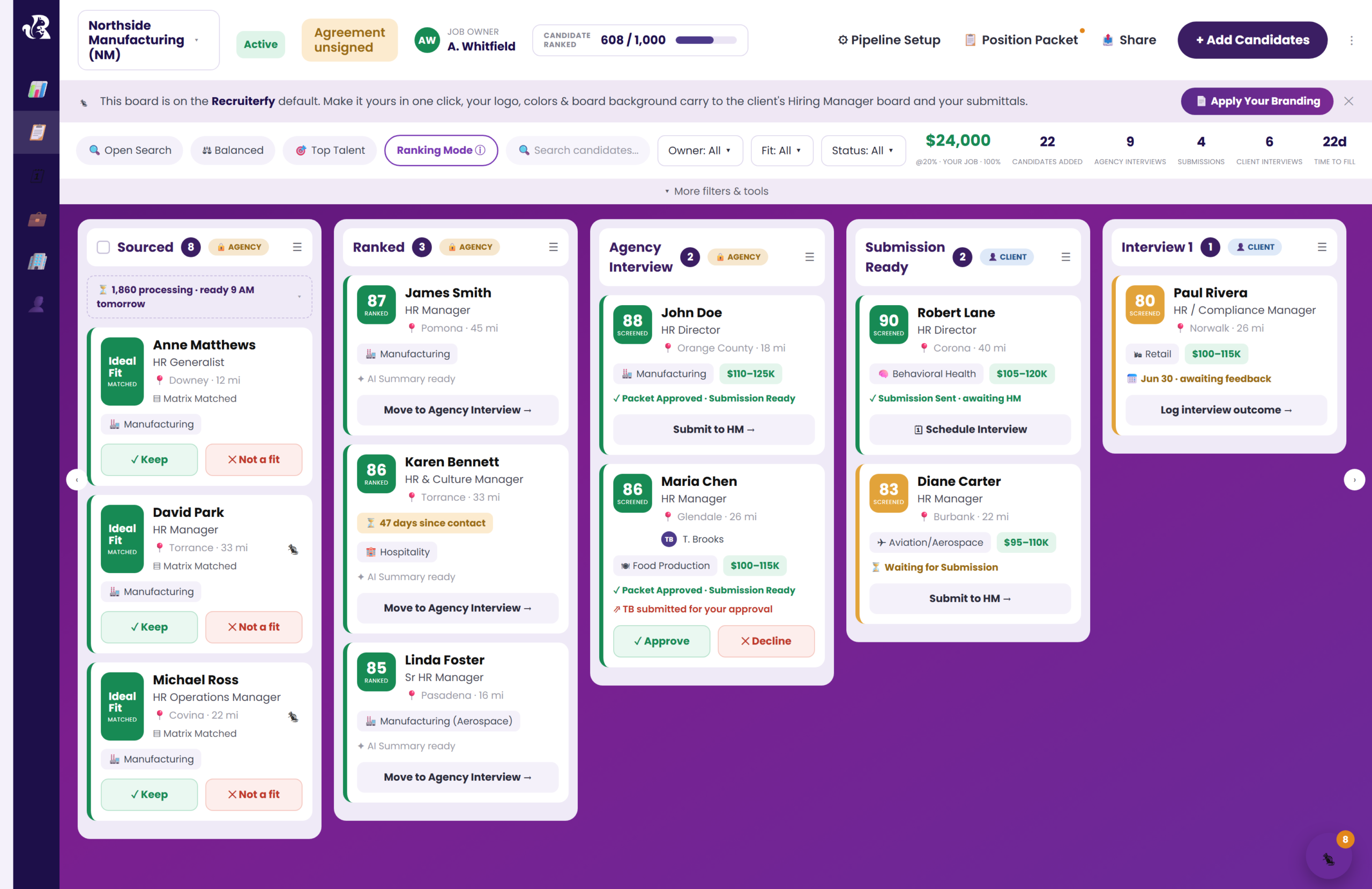
Recruiterfy is built to solve that exact gap. Instead of relying only on rigid tags or exact keyword matches, Recruiterfy’s AI-driven candidate matrix helps identify aligned candidates across your existing recruiting history, ranks likely fit, and can add those people back into the pipeline when a new search begins. The goal is simple: start with what your business already knows before you spend again to rebuild the same shortlist from scratch.
That changes the economics of recruiting in three ways.
First, it reduces dependency on external sourcing for every search. Second, it makes your CRM and ATS data more commercially useful because old candidate interactions become reusable assets instead of dead records. Third, it gives recruiters a faster path to a credible shortlist because they do not have to restart discovery from zero.
The bigger point is strategic. Candidate ownership is not just a data issue. It is a margin issue. It is a speed issue. It is a recruiter productivity issue. And increasingly, it is a growth issue.
The agencies that win in the next stage of recruiting will not be the ones that post the most jobs or buy the most traffic. They will be the ones that build the best candidate memory and know how to activate it quickly.
Job boards should amplify your recruiting engine. They should not replace it. When your internal database becomes searchable, usable, and commercially alive, every new search gets cheaper, faster, and smarter.
That is what Recruiterfy is designed to do: help your team stop renting access to talent you already earned.
One hundred founding teams get Recruiterfy at the best rate we will ever offer, with a
live founder session every week. Admission is by application, and we cap how many
firms we admit per specialty and region.
Qualify for the Founders Club
Not sure yet? Join the Waitlist for launch updates, early product previews.