By Leigh Walker | Founder & CEO, Recruiterfy.ai
Most recruiting dashboards are full of activity numbers and thin on decision value.
Lots of teams can show how many applicants came in, how many calls were booked, or how many candidates reached each stage. Far fewer can explain whether the recruiting engine is getting more efficient, whether the existing database is being used well, or whether recruiter time is being spent on the work that actually improves outcomes.
That gap matters because recruiting is not a side expense anymore. It is a major operating lever.
SHRM’s 2025 benchmarking data found that recruiting now takes an average of 26% of the total HR budget. The same research put average nonexecutive cost-per-hire at $5,475 and executive cost-per-hire at $35,879. SHRM also reported that only 20% of organizations track quality of hire, even though time to fill remains about a month and a half.
LinkedIn’s 2025 Future of Recruiting report shows why this issue is becoming more urgent. Eighty-nine percent of talent acquisition professionals said measuring quality of hire will become increasingly important, but only 25% felt highly confident in their organization’s ability to do it. Sixty-one percent said AI could help improve how they measure it.
So what should leaders actually put in front of the board?
- Candidate rediscovery rate
What percentage of shortlisted or submitted candidates came from your existing database, prior pipeline, or past recruiter relationships?
This is one of the clearest indicators of whether your recruiting engine is building reusable value or constantly starting from zero. - Time to first qualified shortlist
Not just time to fill. How long does it take to produce the first shortlist a hiring manager or client would actually want to review?
This is where productivity shows up fastest. Bullhorn’s 2026 Industry Trends research found that 56% of top-performing firms were now placing candidates in under 10 days. Leaders should know how close their own team is getting to that kind of speed. - Screening efficiency
How much recruiter time is spent getting from raw applicant pool to viable first conversation set?
This is where AI support should show measurable value. If new tools are not reducing screening effort, they are probably not improving the workflow in a meaningful way. - Submission-to-interview conversion
A high-volume submission model can hide poor fit. This metric reveals whether your shortlists are actually credible.
Better ranking and better calibration should improve this number over time. - Candidate response SLA
How quickly does your team acknowledge, respond to, or advance viable candidates?
This should be a leadership metric, not just a recruiter habit, because slow response hurts both candidate experience and commercial performance. - Quality of fit or quality of hire proxy
Even if your organization is not yet measuring full long-term quality of hire, you can still track early indicators: interview progression, hiring manager acceptance, offer conversion, retention checkpoints, or post-placement performance signals.
The point is not perfection. The point is moving beyond pure activity counting.
This is where Recruiterfy can create a stronger leadership story.
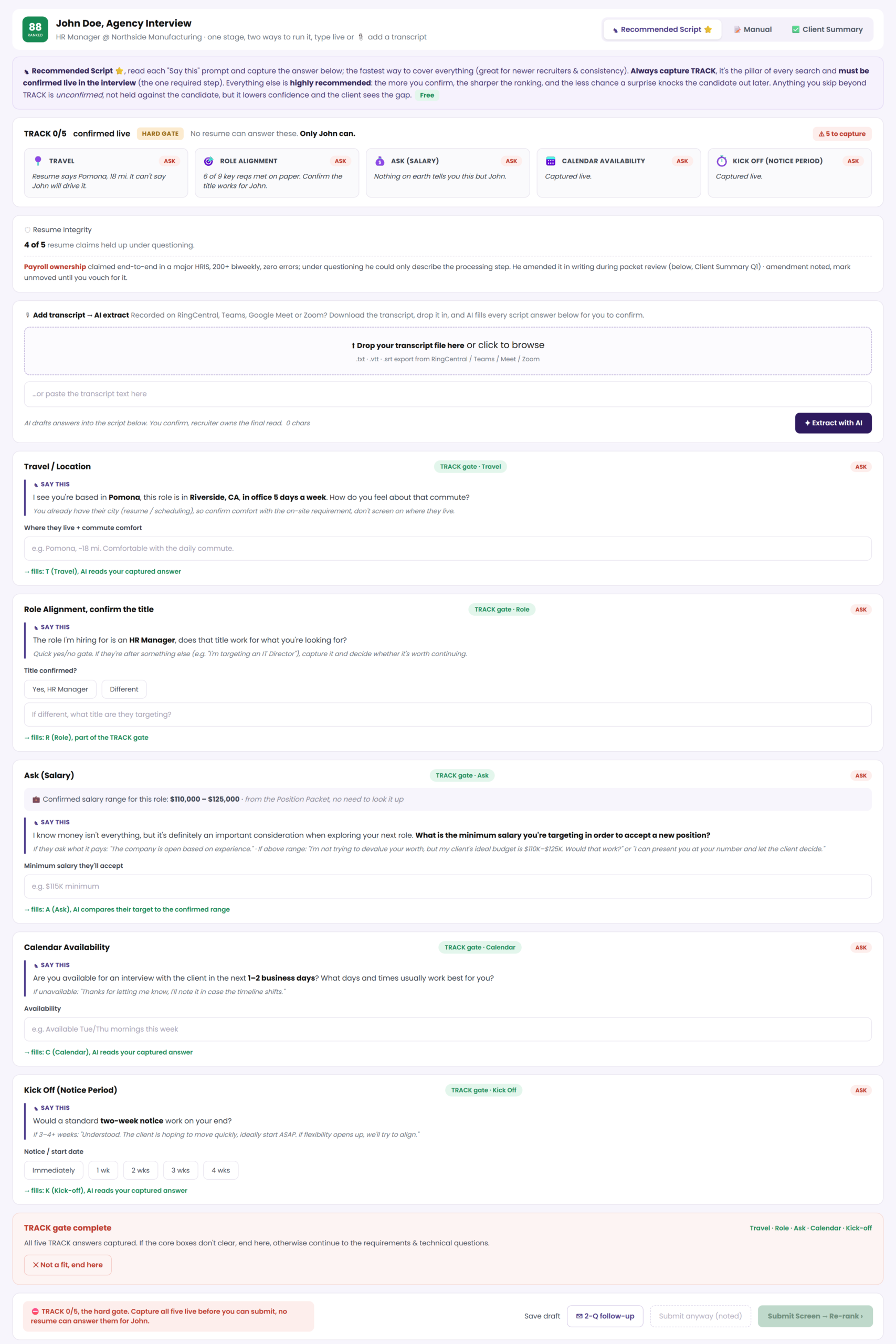
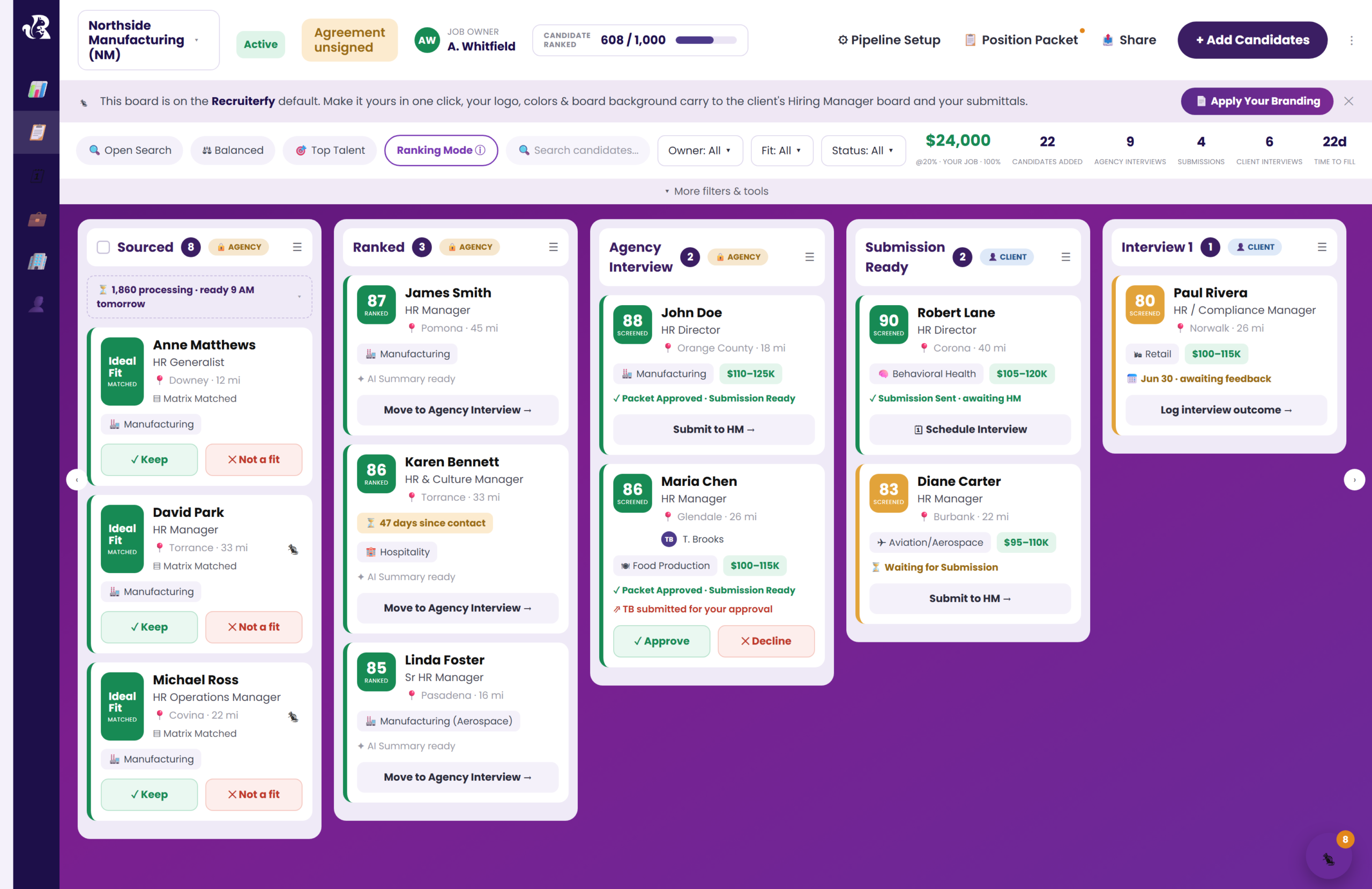
Because Recruiterfy is designed around candidate ranking, pre-screening, structured summaries, and top-of-funnel workflow visibility, it supports the kinds of metrics that leadership teams actually need: speed to shortlist, fit quality, rediscovery value, and recruiter time recovery.
Boards do not need more recruiting noise.
They need better recruiting signal.
The recruiting teams that stand out over the next few years will be the ones that can show not just how busy they are, but how intelligently the system is operating.
That is the difference between a recruiting dashboard and a recruiting operating model.
Recruiterfy should help you build the second one.
One hundred founding teams get Recruiterfy at the best rate we will ever offer, with a
live founder session every week. Admission is by application, and we cap how many
firms we admit per specialty and region.
Qualify for the Founders Club
Not sure yet? Join the Waitlist for launch updates, early product previews.